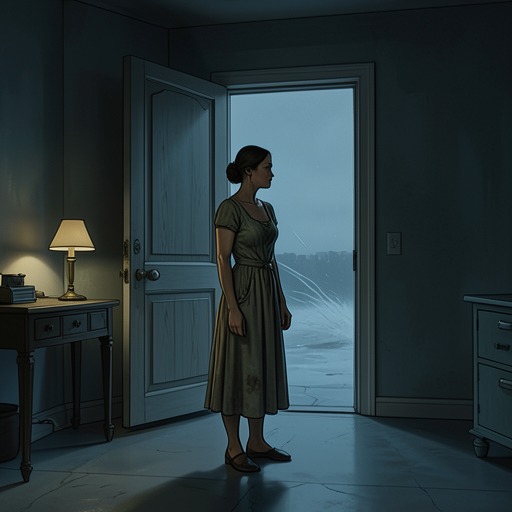
Rosario’s Escape from the Clinic and Disappearance After the Storm
Ofrenda a la tormentaRosario’s escape from the clinic and disappearance after the storm is a turning point because it leaves her fate uncertain while exposing how much of the night may have been prepared in advance. The river offers an apparently conclusive explanation: her coat is found there, and a large search supports the belief that she was swept away. Amaia, however, insists that what she witnessed does not fit the image of a frail older woman overcome by the elements. Her refusal to accept the official conclusion turns a presumed death into an unresolved pursuit.
Background and the Escape Plan
Amaia’s reconstruction begins with Rosario’s departure from the clinic alongside Doctor Berasategui. In questioning him, she argues that the escape was not an improvised flight. A gap separates Rosario’s exit from the hospital and her later appearance at Engrasi’s house; Amaia says Rosario did not change clothes either at Doctor Berasategui’s father’s house or in his car. To her, that interval means the pair went somewhere else, and the detour points to a prepared safe house in Baztán.
Amaia’s theory gives the otherwise unexplained pause a practical purpose. The hidden house could provide a place to keep objects that Doctor Berasategui could not discard, shelter Rosario, and allow a change of clothes before they continued. Amaia further suspects that he took Rosario there that night and may have returned there after the cave. Doctor Berasategui denies knowing what she means, but his answer does not resolve the missing interval or identify an alternative place where Rosario could have changed.
Sarasola later offers a broader interpretation of Doctor Berasategui’s role. He believes Berasategui had spent years encouraging men to commit murders, had constructed a plot implicating Amaia by leaving her ancestors’ bones in a church, and had planned Rosario’s departure from Clínica Santa María de las Nieves and her escape from the clinic. In Sarasola’s view, the arrangements for that night were meticulous enough to account for contingencies. This remains an assessment, not a confirmed account of every step, but it strengthens the possibility that Rosario’s disappearance was the outcome of planning rather than a sudden decision.
The Night, the Cave, and the River
Amaia’s defense of Rosario rests on what she says she saw. She recalls that Rosario left the hospital on her own feet, came to the house where Amaia was, and took Ibai. From the place where the car had been left, Rosario then walked hundreds of metres through the mountain to the cave. Amaia emphasizes the contrast between the older woman others might imagine and the Rosario she encountered: determined and sure-footed. In her account, Rosario’s actions that night demonstrate capacity and resolve, not helplessness.
The conditions nevertheless make the escape difficult to explain. It took place at night, during a storm, with the river in flood. James challenges Amaia’s assumption that Rosario could have managed such a journey, pointing out that she was an elderly woman who would have had to ford the swollen water. His objection is practical: the weather, terrain, and river all make survival seem unlikely. Amaia’s answer is experiential rather than statistical; she had been there and had seen Rosario move through the night.
The cave is also central to Amaia’s theory of the separation between Rosario and Doctor Berasategui. She believes the hidden house provided a staging point, and that after leaving the cave Rosario may have returned to it, leaving him behind. The proposed route is not established as fact, but it explains why Amaia questions the assumption that the river was the final destination. She asks where Rosario went after the cave and where she is now, directing attention away from the coat and toward the unaccounted-for movements of the people involved.
Search and Competing Explanations
The evidence for drowning is substantial within the account. More than two hundred people searched for Rosario for hours; her coat appeared in the river; and the Spanish National Guard, Civil Protection, Inspector Iriarte, and a judge agreed that the water had carried her away. James invokes this consensus against Amaia, treating the search and the recovered coat as a conclusion supported by both the physical evidence and the authorities’ judgment.
Amaia does not deny that the river explanation is plausible. She rejects it. As she rocks Ibai, who has begun to whimper in response to the tension, she shakes her head and maintains that Rosario was not swept away. The scene places an official account built from traces and a search against Amaia’s personal witness to Rosario’s actions. Her certainty cannot establish where Rosario went, but it prevents the evidence of the coat from closing the question.
Investigation and Unresolved Fate
The later questioning of Doctor Berasategui makes the disappearance an investigative problem rather than merely a search for a body. Amaia presses him about the house, the unaccounted time, and whether Rosario is alive. His evasive responses do not confirm her theory, yet she reads his apparent preparation as evidence that he had planned for the escape and that Rosario followed the plan. His refusal to identify the place leaves the proposed safe house as a lead rather than a discovery.
Jonan Etxaide also asks Sarasola whether Doctor Berasategui discussed Rosario’s escape and the events of that night during prison visits. Sarasola says their conversations were technical and abstract, focused on Berasategui’s own behavior; he does not provide a firsthand account of Rosario’s route. He warns that people who have approached evil lie, so their words should not be trusted. Despite that limitation, Sarasola concludes that Rosario may still be somewhere outside. Her survival remains unverified, and the event ends not with a recovered body or confirmed refuge, but with competing interpretations of an absence that Amaia refuses to call a death.